
Private Label Body Care: The Documents You Cannot Skip
The documents matter more than the sample in private label body care, because a compliant file is what lets you sell, and a missing one stops you at customs. The core set is small and stable: the formula and ingredient list, the fragrance compliance statement, stability and micro reports, the label text and batch records. Different markets add their own layers, but everything rests on the same core. Build the file once, and reuse it for every market.
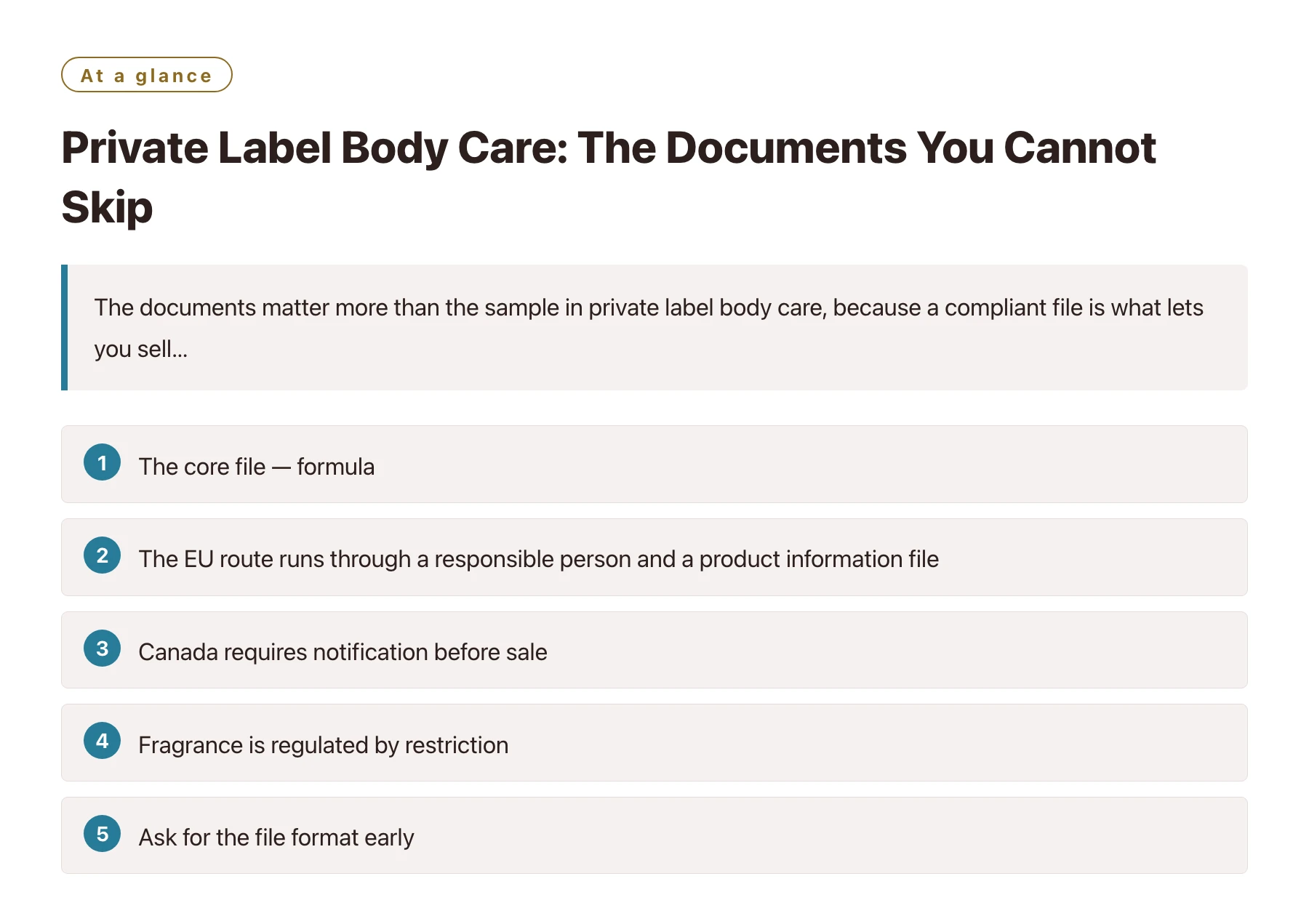
Key takeaways
- The core file — formula, ingredients, allergen statement, stability, micro and batch record — is the same core for every market.
- The EU route runs through a responsible person and a product information file; that is a legal role, not an optional favour.
- Canada requires notification before sale, with an ingredient hotlist to check against.
- Fragrance is regulated by restriction, and the industry standards library is the reference most suppliers quote.
- Ask for the file format early; the content must match the batch you actually ship.
Two founders can launch the same body wash in the same country, and one will get stopped at customs while the other clears in a day. The difference is rarely the product. It is the file.
This article maps the documents a private label body care line needs, who prepares each one, and how the market you sell into changes the list.
It is written to be practical: read it once, and the document list stops being a mystery.
The core file
Every market starts from the same core: what is in the product, what the fragrance complies with, whether the format survives its shelf life, what the label says and what happened on the batch you ship. Everything else in compliance is a market-specific layer on top of that core.
The concentrate layer
The fragrance itself is regulated by restriction rather than by approval: individual ingredients are limited on safety grounds, and the industry's standards library is the published reference most suppliers work to when they build a compliant oil [1].
The product layer
The finished format — wash, lotion or oil — is what stability and micro testing cover. A compliant concentrate alone proves nothing about the product that sits on the shelf. Stability and micro testing are standard services offered by third-party laboratories aligned with cosmetics GMP, which makes the product layer of the file routine to obtain [2].
The market layer
Each destination adds its own requirements on top: notification, a responsible person, a dossier or specific labelling. Name the markets before the file is built, because retrofitting a dossier is slower than building it right.
Who prepares what
| Document | What it proves | Who prepares it |
|---|---|---|
| Formula and ingredient list | What is actually in the product | Factory, checked by the brand |
| Fragrance compliance statement | The oil sits within restriction standards | Factory or the oil supplier |
| Stability and micro reports | The format survives its shelf life safely | Factory or a third-party lab |
| Label text | Legal name, allergens, storage, warnings | Brand, validated by the factory |
| Batch record | The shipped run matches the approved reference | Factory, issued per batch |
| Market dossier | Responsible person, notification, registration | Factory and brand together |
Notice who prepares what: the brand owns the label, the factory owns the batch record, and the dossier is shared.
How each market adds its layer
European Union
The EU structure runs through a responsible person and a product information file, and the Commission describes both obligations in plain terms for manufacturers and sellers [3].
Canada
Canada works on notification before sale plus an ingredient hotlist; Health Canada publishes the requirements and the list a formulator has to check [4].
The rest
Other markets sit somewhere between these two shapes. The pattern to remember is that the core file is universal and the layers vary, so build the core once and price the layers per market.
Where the factory fits
If you are working with a private label perfume manufacturer in China, the file is usually assembled in one place, because the fragrance, the base and the filling live in the same building and the documents move with the batch.
Start the evaluation with the maker's own disclosures; most suppliers publish their management-system certifications on their site, in a section such as the one on its background and certifications.
For a larger programme, the same maker often becomes the long-term perfume production partner in China, which keeps the entire dossier in one file instead of scattered across suppliers.
Never ship on 'trust me, it is fine.' The market does not audit trust; it audits the file. If the file is not ready, the launch date is not real yet.
Sources
- IFRA Standards Library (International Fragrance Association) —— The IFRA Standards Library lists the restrictions the fragrance industry applies to individual fragrance ingredients, based on safety assessments; it is the reference point for compliant fragrance formulation.
- SGS: Cosmetics, Personal Care & Household Testing —— Testing, inspection and certification services for cosmetics and personal care, including microbiological, stability and safety testing aligned with cosmetics GMP.
- European Commission: Cosmetics in the EU —— The European Commission's overview of EU cosmetics rules, including the responsible person, product information file and safety report requirements.
- Health Canada: Cosmetic Safety —— Health Canada's cosmetics pages, covering cosmetic notification, the ingredient hotlist and safety requirements for cosmetics sold in Canada.
Frequently asked questions
Which documents do I actually need to sell body care?
The core set: formula and ingredient list, allergen declaration, fragrance compliance statement, stability and micro reports, label text and batch records. Your destination market then adds its own dossier layer on top.
Who is the responsible person for my EU sales?
A legal or natural person established in the EU, either your importer or a designated entity, who holds the product information file and can answer the authorities. The brand and the factory both feed the file, but the responsibility sits in the EU.
Do I need to register my product in Canada?
Yes in effect: cosmetics must be notified to Health Canada before sale, and the ingredient list has to be checked against the published hotlist. The notification process and the list are both documented by Health Canada.
What is a fragrance compliance statement?
A written declaration, usually from the oil supplier, that the fragrance complies with current restriction standards for its intended use. Retailers in many markets ask for it as routine, so it belongs in the core file.
Can one factory provide all the documents?
In a full private label project, usually yes, because the fragrance, the base and the filling are all in-house and the records follow one batch. Check which documents are issued by third parties, and ask to see one example of each.
Move from commentary to category leadership.
Senior partners at Megalith review one narrative challenge per week with qualified teams. No deck, no pitch — a working session.